
Structural Monitoring for Ice-Class Vessels
Arctic trade routes are becoming increasingly viable, offshore energy projects are pushing further north, and naval vessels are patrolling in more extreme weather regions, meaning ice-class vessels are finding themselves at the forefront of year-round operations.
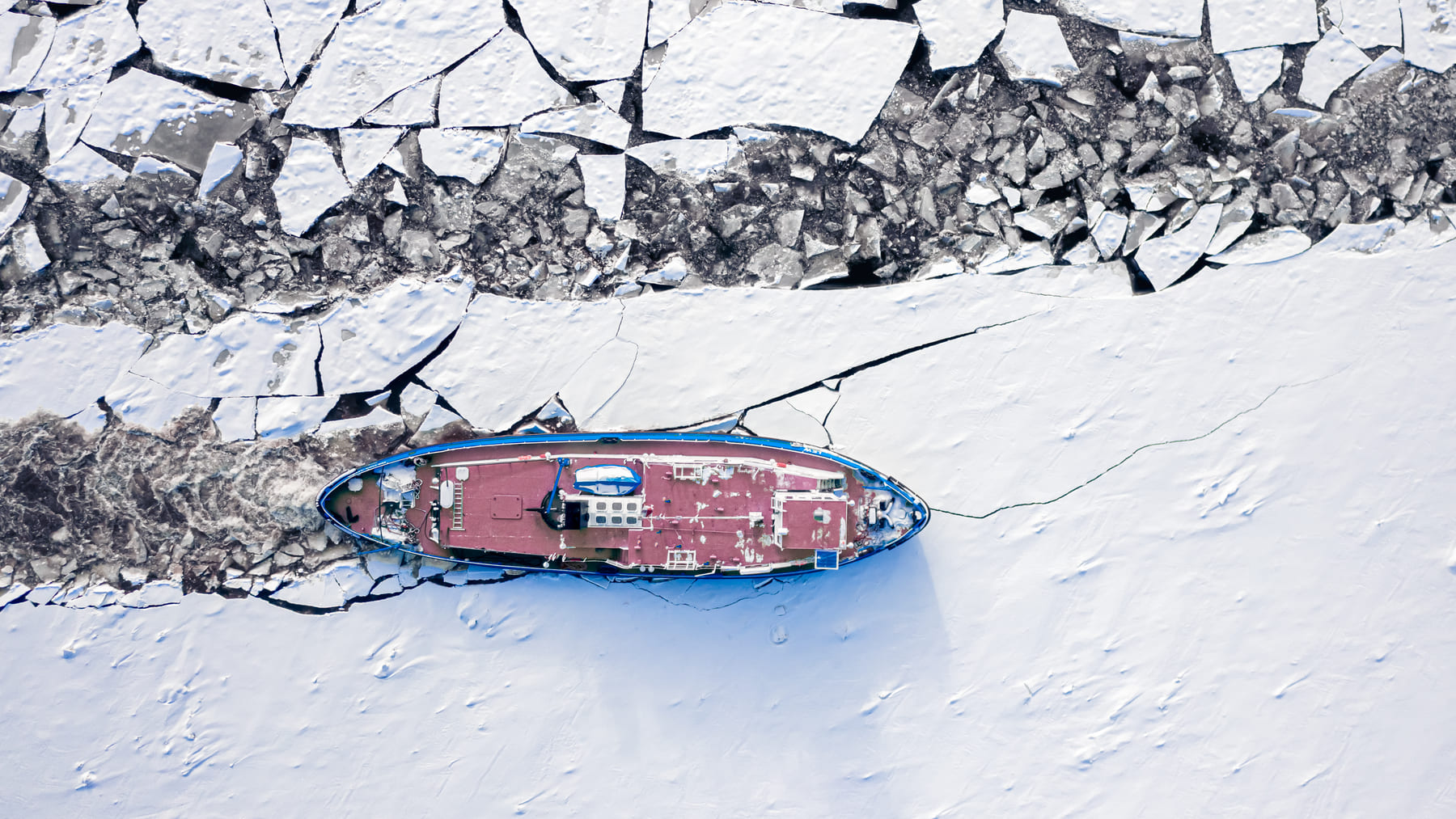
These ships, from LNG carriers and cargo ships to offshore supply vessels, research ships, warships, patrol craft, and coastguard cutters must navigate some of the harshest environments on Earth, and whether designed for scientific exploration or maritime security, the structural challenges remain the same.
Unique demands on naval vessels
Unlike commercial vessels that may alter routes or delay departures, naval and coast-guard craft are often mission-bound and must proceed regardless of ice conditions. This places unique demands on structural resilience. All vessels in ice face the risk of losing propulsion or encountering pressure zones, especially under low visibility or poor lighting conditions. In such circumstances, real-time insight into structural loading and the safety margins remaining becomes critical for navigators. Understanding these margins supports more confident decision-making, even in the face of rapidly evolving ice conditions.
Unlike wave-driven stress loads, ice impacts are abrupt, concentrated, and potentially severe. Even vessels built to polar class standards can be caught off guard by a shifting ice field or an unexpected ridge. For shipowners, navies and coastguards, the ability to manage this risk in real time is essential. And it’s exactly what Light Structures’ SENSFIB ICE is designed to deliver.
Real-Time Ice Load Intelligence at Sea
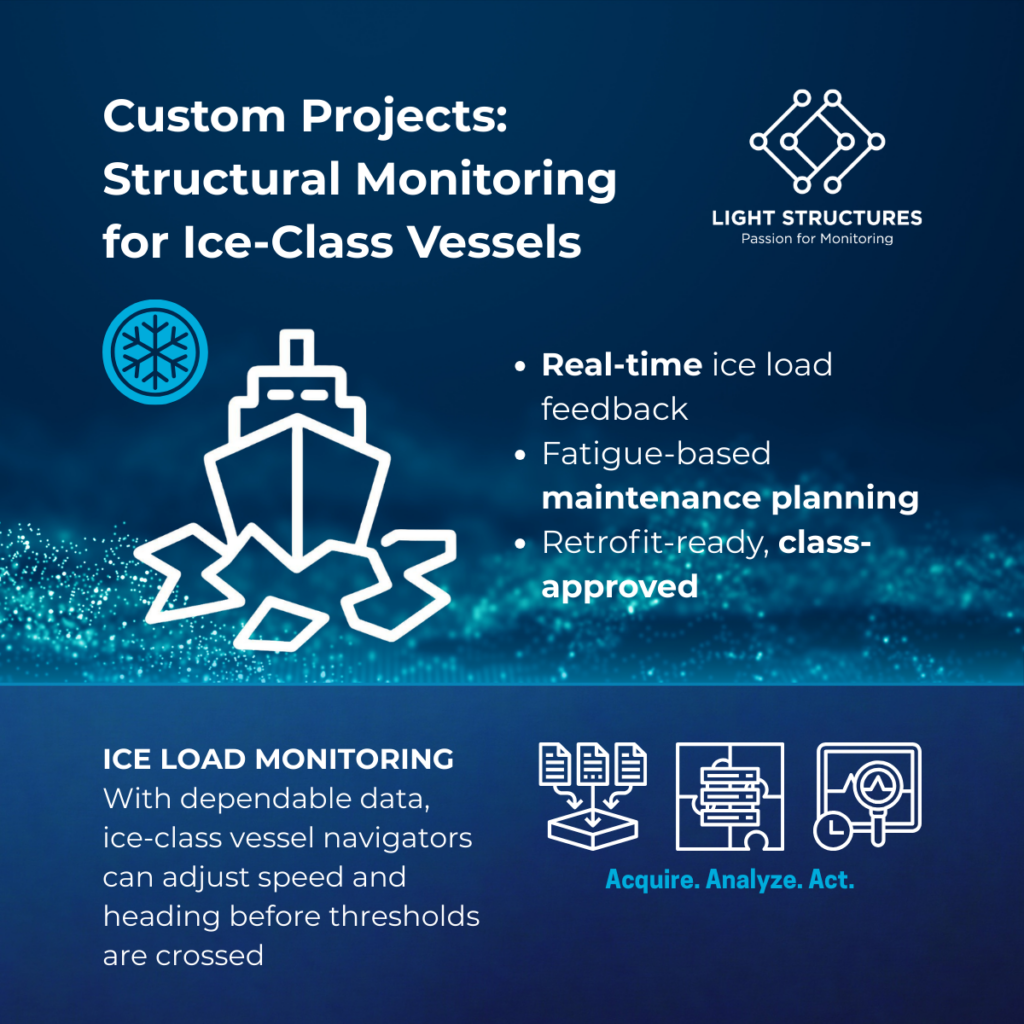
At the core of SENSFIB ICE is Light Structures’ proprietary fibre optic sensor technology. Installed at critical locations on the hull, especially around the bow and waterline, Fibre Bragg Grating (FBG) sensors continuously measure strain and transmit real-time data to the bridge. This gives crews a live picture of how the hull is responding to ice contact. For many operators, this feedback supports safe navigation by enabling better informed decision-making.
Instead of reacting to damage after it occurs, navigators can now adjust speed and heading before thresholds are crossed. The system effectively becomes a structural ‘early warning’ layer that enhances safety while enabling more confident passage through ice fields.
Long-Term Value Through Fatigue Monitoring
While real-time awareness is a critical feature, SENSFIB ICE also supports long-term asset management. Every stress event is logged and available for onshore review, allowing technical teams to monitor cumulative fatigue and plan maintenance based on actual structural loading. This capability is especially valuable in polar regions, where limited drydocking options and unpredictable ice conditions make conventional maintenance planning unreliable. With SENSFIB ICE, inspection intervals can be optimised, emergency repairs avoided, and vessel service life extended. In environments where national security, emergency response, or scientific access depends on the availability of ice-capable ships, ensuring structural readiness is critical. At the same time, every additional week of reliable operation, whether for safety, research, or commercial purposes, can deliver substantial value, making this kind of precision a direct contributor to both mission success and profitability.
Retrofit Ready, Class Approved
One of the defining advantages of SENSFIB ICE is its versatility. The system is approved by all major classification societies and is equally suitable for retrofits and newbuilds, regardless of if they are intended for commercial or naval and security operations. Installation is straightforward: sensors are adhesive mounted without the need for welding or hot work, and there’s no requirement for periodic recalibration. This makes the solution ideal not only for new polar-capable vessels, but also for upgrading existing tonnage to meet modern performance and safety expectations.
As polar shipping and security become even more critical, structural monitoring is evolving as a core enabler of safe and sustainable Arctic operations. SENSFIB ICE provides the visibility needed to operate with confidence in unpredictable conditions, while unlocking the full lifecycle value of ice-class vessels. By turning real-world data into smarter decisions at sea and ashore, Light Structures is helping vessel operators, navies and coastguards navigate ice with more control, less downtime, and greater long-term certainty.