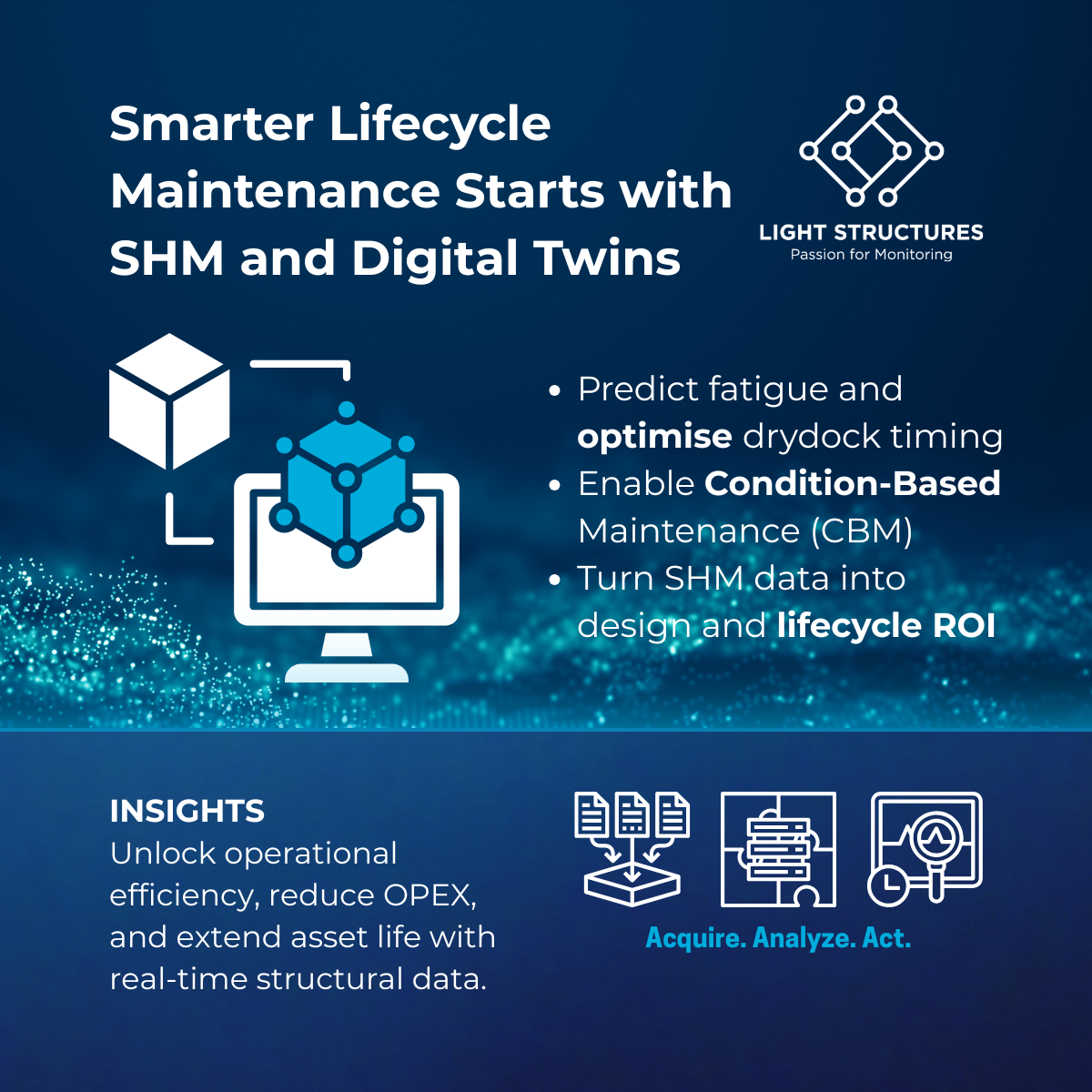
Smarter Lifecycle Maintenance Starts with SHM and Digital Twins
For many shipowners and offshore operators, the most important question today isn’t whether to digitalise, it’s how to ensure that digital investments directly improve operations and reduce cost over time.
One area where this is becoming clear is in the combination of Structural Health Monitoring (SHM) and digital twin technology.
Structural monitoring systems have always been seen as safety tools. But as the industry shifts toward data-driven operations, the value proposition is evolving. SHM is now a key enabler of predictive maintenance strategies, smarter asset utilisation, and digital lifecycle management, and digital twins are the platform where these capabilities come together.
Moving beyond the static model
When a digital twin is informed by real-time stress, fatigue, and vibration data from SHM systems like SENSFIB, the result is a living 3D model of the ship, continuously updated and able to simulate how structural elements respond to real-world conditions.
This allows operators to do something they’ve never been able to do before: accurately forecast when and where structural fatigue will accumulate, compare this with the design life, and take action before problems develop. For instance, if a tanker hits unusually heavy weather in year two of a 20-year life, the digital twin can flag how that single event affected the fatigue budget. That changes the game from “repair when we see it” to “intervene before it matters.”
Enabling Condition-Based Maintenance
One of the main benefits here is the shift to condition-based maintenance. Instead of performing inspections on a fixed schedule, operators can monitor in-service data continuously. Fatigue hotspots, slamming loads, or high-cycle vibration effects are logged and trended. If stress accumulates faster in one area, targeted intervention can be planned, not in drydock, but when it makes operational sense.
This improves safety while signifcantly optimises maintenance and associated costs. It reduces the time ships spend in drydock, lowers the frequency of intrusive inspections, and helps owners extend intervals between class surveys, especially when working with classification notations like DNV FMS(SENS) or ABS SMART(SHM).
Data-driven ROI
Another positive impact of the integration of SHM data and digital twins is commercial continuity. The ability to avoid unplanned shutdowns, to drydock on your schedule, not because a crack was discovered late, adds months or years of productive service and millions in preserved revenue.
Consider FPSOs, where one day of downtime can cost upwards of $1 million. Or container ships that lose cargo due to unmeasured torsional stress. With SHM data streamed into digital twins, operators can manage these risks proactively, turning uncertainty into insight, and insight into action.
Even better, this data also loops back to support design optimisation. When a class of ships has SHM installed from delivery, the real-world fatigue data they generate becomes a feedback loop for naval architects and shipyards. Next-in-class vessels can be lighter, better balanced, and designed with confidence, not overbuilt based on conservative assumptions.
From data points to decision points
At Light Structures, we see this evolution happening in real time. More owners are integrating SENSFIB into digital platforms, using fatigue analytics not only to meet class requirements but to extend operational lives, fine-tune drydock schedules, and reduce inspection costs.
SHM, once perceived as a safety system, is now a strategic management tool. Both SHM and digital twins may have started as technical solutions, but their value today extends to helping assets stay operational, profitable, and one step ahead of failure.